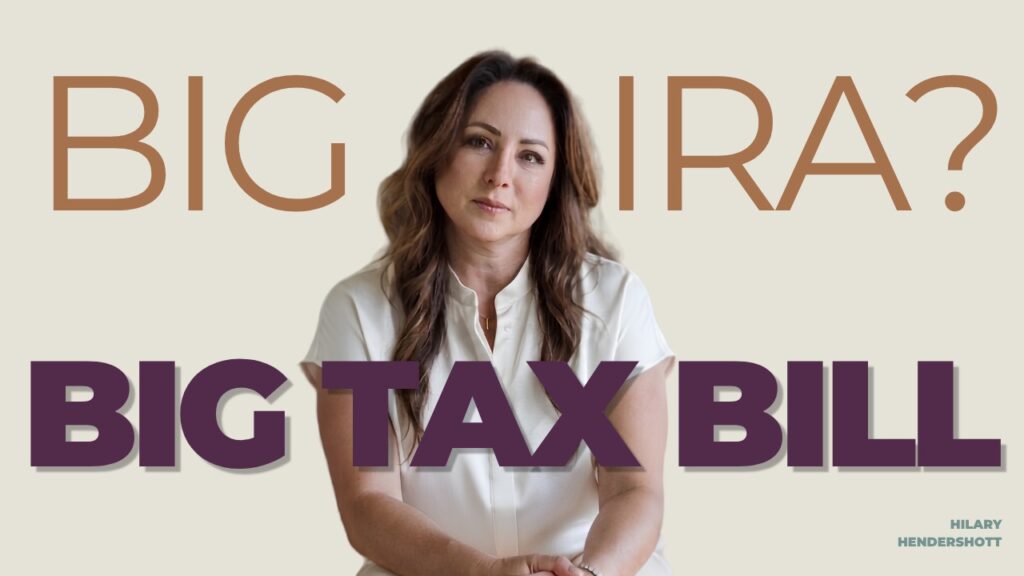
A large IRA can feel like proof that you did everything right.
You saved, invested, deferred taxes, and built wealth over time. But once required minimum distributions begin, that same IRA can start forcing large taxable withdrawals whether you need the money or not.
Hilary Hendershott explains the RMD trap and why large IRAs can create bigger tax problems in retirement.
Required minimum distributions can push you into higher tax brackets, increase the taxable portion of your Social Security, and even trigger higher Medicare premiums. That is why RMDs can feel like a success penalty: the accounts you carefully built may eventually reduce your flexibility and control.
Hilary also explains why common defensive strategies, like qualified charitable distributions, may help in a given year but do not always solve the larger planning issue.
The real opportunity is to think about RMDs as part of a coordinated long-term strategy. Roth conversions, tax offsets, and tax-aware investment strategies can work together to reduce future RMD pressure without creating an unnecessarily large tax bill today.
At Hendershott Wealth Management, we call this Ultra Tax Efficient Wealth Management®. It is an ongoing process that coordinates tax-aware decisions across your full financial life.
If your IRA is starting to feel like a loss of control, that may be a signal that your strategy needs to evolve.
Schedule a conversation with our team:
HendershottWealth.com/contact
Here’s what you’ll find out in this week’s episode of Love, your Money:
- 00:46 The RMD trap inside large IRAs
- 01:06 Why disciplined saving can create forced withdrawals
- 01:53 Why flexibility becomes limited once RMDs begin
- 02:43 A coordinated strategy for reducing future RMD pressure
- 03:17 Moving from reacting each year to designing the outcome
- 03:57 Ultra Tax Efficient Wealth Management®
- 04:12 When your IRA strategy needs to evolve
Resources and Related to Love, your Money Content
- HerMoney & Alliance for Lifetime Income (2024 Women, Money & Retirement Study): https://hermoney.com/invest/financial-planning/yes-even-higher-earning-women-worry-about-money/
- Mutual of Omaha (2025 Women’s Confidence and Retirement Survey): https://www.mutualofomaha.com/advice/financial-planning/build-your-financial-future/financial-confidence-lower-among-women-new-survey-shows
- InvestmentNews: https://www.investmentnews.com/retirement-planning/women-are-wealthier-than-ever-so-why-do-so-many-feel-financially-insecure/261200
- Standards Board for Financial Planning 2025 Research: https://www.standard.com/eforms/25463.pdf
Enjoy the Show?
- Be sure to subscribe to Money Love Notes so that you get our latest announcements, offers, articles, and resources straight to your inbox!
- Don’t miss an episode, subscribe via Apple Podcasts, Spotify, Google Podcasts, Overcast, or wherever you listen!
- Leave us a review on Apple Podcasts and share the show with your friends.
- Don’t miss out on the 7 Steps to Wealth Audio Guide! It’s free and comes with weekly emails that walk you through each step.
Transcript
[EPISODE]
[00:00:45] Hilary Hendershott: At some point, the IRS decides it’s time, and if you have a large IRA, that moment can change your entire tax picture. Required minimum distributions begin. And you don’t really get to choose the timing, although it happens in your 70s, not because you need the money, but because the tax system does. Here’s what this is going to look like for you in real life.
[00:01:08] You spent years being disciplined, saving, deferring taxes, growing your portfolio, and now those same accounts can force out large withdrawals whether you need them or not, which means a part of your financial life is no longer fully in your control. If your IRA is substantial in size, those distributions can be massive.
[00:01:33] They can be large enough to push you into higher tax brackets and trigger what many people don’t see coming, and that’s higher Medicare premiums. More of your Social Security also becomes taxable, and all because of income you didn’t actually need to take, and that’s why it can feel like a success penalty.
[00:01:52] So, now here’s the part that creates frustration. Once RMDs begin, your flexibility is limited. Yes, you can convert to a Roth, but that creates a large tax bill today. And if markets are strong, your IRA can grow faster than you’re distributing it, which means the problem doesn’t shrink, it compounds, like trying to drain a bathtub while the faucet’s still running.
[00:02:16] So, most people play defense. They look for ways to reduce this year’s tax bill. Qualified charitable distributions are a good example. If you’re charitably inclined, those can be very effective, but they don’t let you preserve the wealth for yourself or your heirs, and they don’t solve the underlying issue.
[00:02:34] They address this year, again, not the underlying issue, so next year, the process starts again. There is another way to think about this, not as a single-year problem, but as a coordinated strategy because if you step back, there are really two goals. You want to reduce future RMDs without creating an unnecessarily large tax bill today.
[00:02:59] You can accomplish this, and coordination matters. At a high level, Roth conversions move assets from future taxable distributions into a tax-free structure. That reduces RMD pressure later. But Roth conversions create income today. So, the question becomes: how do you offset that income? Well, there are certain investment strategies that my team and I are using with clients now that can safely generate tax offsets that help reduce the tax impact of those conversions.
[00:03:33] What we’re able to accomplish isn’t eliminating taxes, it’s deferring them and giving investors more control over when and how taxes show up, so more capital stays working for you instead of going to the IRS, and your future RMDs become more manageable. That’s the shift from reacting each year to designing the outcome over time.
[00:03:56] At Hendershott Wealth Management, this is the lens we use. We call it Ultra Tax Efficient Wealth ManagementSM. It’s not a product. It is an ongoing process that coordinates these decisions across your entire financial life. So, if you’re looking at your IRA and starting to feel that loss of control, that’s not unusual.
[00:04:19] It’s a signal that the strategy needs to evolve. If you’d like help thinking through how this applies to your situation, you can go to hendershottwealth.com. Click Schedule a Call, and fill out the contact form there. That’s the best way to start a conversation with me and my team. It’s a thoughtful, low-pressure meeting focused on understanding your situation and helping you decide what to do next.
[00:04:45] Thanks for being here.
[END]
Disclosure:
All investing involves risk, including the potential loss of principal, and there is no guarantee that any investment plan or strategy will be successful.
Advisory services are provided by Hendershott Wealth Management, LLC (“HWM”), an investment advisor registered with the U.S. Securities and Exchange Commission. Registration does not imply a certain level of skill or training.
Content discussed is for information purposes only and does not constitute an offer, or solicitation of an offer, or any advice, or recommendation to purchase any securities or other financial instruments–and may not be construed as such.
All information or ideas provided should be discussed in detail with an advisor, accountant, or legal counsel prior to implementation–and all examples are hypothetical, not reflective of actual executed transactions or client experiences.
The realized tax benefits associated with tax-aware strategies may be less than expected or may not materialize due to the economic performance of the strategy, an investor’s particular circumstances, prospective or retroactive change in applicable tax law, and/or a successful challenge by the IRS. In the case of an IRS challenge, penalties may apply.
There is a risk of substantial loss associated with trading commodities, futures, options, derivatives and other financial instruments. Before trading, investors should carefully consider their financial position and risk tolerance to determine if the proposed trading style is appropriate.
When trading these instruments, one could lose the full balance of their account. It is also possible to lose more than the initial deposit when trading derivatives and using leverage. All funds committed to such a trading strategy should be purely risk capital.
Investment minimums apply. The investment strategy and themes discussed herein may be unsuitable for investors depending on their specific investment objectives and financial situation.
All content originates with the Hendershott Wealth Management team. AI software was used to support clarity and tone during editing. Final content was written and reviewed by the Hendershott Wealth Management team for accuracy.